Let’s talk about Michael Lorenzen
What might he bring to the rebuilding Colorado Rockies?

One difference between the old Colorado Rockies front office and the new one is communication: The Paul DePodesta Era has been marked by more openness than we’ve seen from the Rockies in some time.
For example, general manager Josh Byrnes did two interviews last week, one with podcaster Rob Bradford and another with Rockies beat writer Thomas Harding.
In his interview with Harding, Byrnes made a comment about the Rockies 2026 starting rotation that are worth citing:
“We’ve played out scenarios where we would attempt to bring in two guys who can stabilize that area [emphasis added] – who can not only pitch well but know how to give us some bulk innings, which any team needs,” Byrnes said. “That’s probably how we’re trying to map it out. There is a lot of unknown with what pops up in trades or free agency, but we need to add in that area.”
Pitchers have so rarely chosen to pitch in Colorado’s taxing and hitter-friendly altitude that recent front offices all but swore off chasing free agents. But Byrnes said early feedback suggests pitchers are more willing to listen than has been believed in recent years.
“There are different tiers of free agency,” Byrnes said. “It’s kind of interesting, without naming names. But with guys on shorter deals, I think there’s some intrigue. Everyone around the game knows it’s harder to pitch in Colorado, but I think a couple of guys want to take on that challenge, and we’ve brought in a pitching group that will turn over every rock to get at it and solve this thing.”
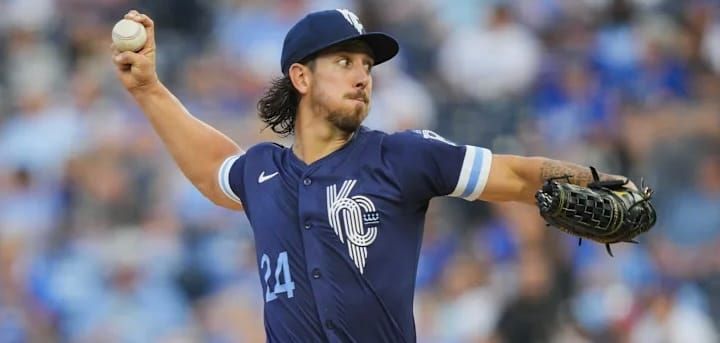
The Rockies made their first significant move on Wednesday when reports indicated that they had signed 34-year-old RHP Michael Lorenzen:
@JeffPassan tweeted Right-hander Michael Lorenzen and the Colorado Rockies are in agreement on a one-year, $8 million contract that includes a club option, sources tell ESPN. Lorenzen, 34, will be a starter for Colorado, which holds a $9 million option for the 2027 season.
— Passanthallich (@passanthalbot.bsky.social) 2026-01-08T02:46:40.081996+00:00
The move has not yet been made official, but it’s worth taking a minute, then, consider what Lorenzen might bring to the Rockies.
Can you provide some background?
A native of Anaheim, California, Lorenzen attended Cal State Fullerton before being drafted by the Cincinnati Reds in the first round of the 2013 MLB Draft. He made his MLB debut in 2015 and has since then played for a number of teams:
- Cincinnati Reds (2015-2021)
- Los Angeles Angels (2022-2023)
- Detroit Tigers (2023)
- Philadelphia Phillies (2023)
- Texas Rangers (2024)
- Kansas City Royals (2024-2025)
There were trades involved in there, too, but you get the idea.
In 2025, Lorenzen pitched to a 4.64 ERA over 141 2/3 innings. He’s also durable, surpassing 130 innings in each of the past three seasons. Over the last four seasons, Lorenzen has a 4.10 ERA with a 19.3% K% and a 8.7% BB%.
Lorenzen had a 4.64 ERA, 8.1 K/9, 2.5 BB/9 in 141.2 IP for the Royals in 2025. He allowed 2 ER or less in 12 of 26 starts and pitched at least 6 innings in 10 starts. He's made 2 starts at Coors Field (2.1 IP, 8 ER in 2015; 5 IP, 5 ER in 2023) and also has 3 scoreless RP appearances.
— Jason R.R. Martinez (FanGraphs/RosterResource) (@rosterresource.fangraphs.com) 2026-01-08T22:12:10.325Z
In the course of his career, Lorenzen has moved from a starting role to pitching out of the bullpen — read more about that here from Davy Andrews. But Lorenzen wants to be a starter (even if he’s move effective as a reliever as Andrews‘ article shows), and the Rockies have apparently agreed to meet his demands.
What’s the pitch mix?
Lorenzen comes to the Rockies with a seven-pitch mix, one of the deepest in MLB. According to Baseball Savant, he throws a four-seamer (21.9%), sinker (18.2%), changeup (17.3%), slider (12.3%), curveball (11.3%), cutter (10.9%), and sweeper (8.2%).
Notable is the fact that he uses all of his pitches
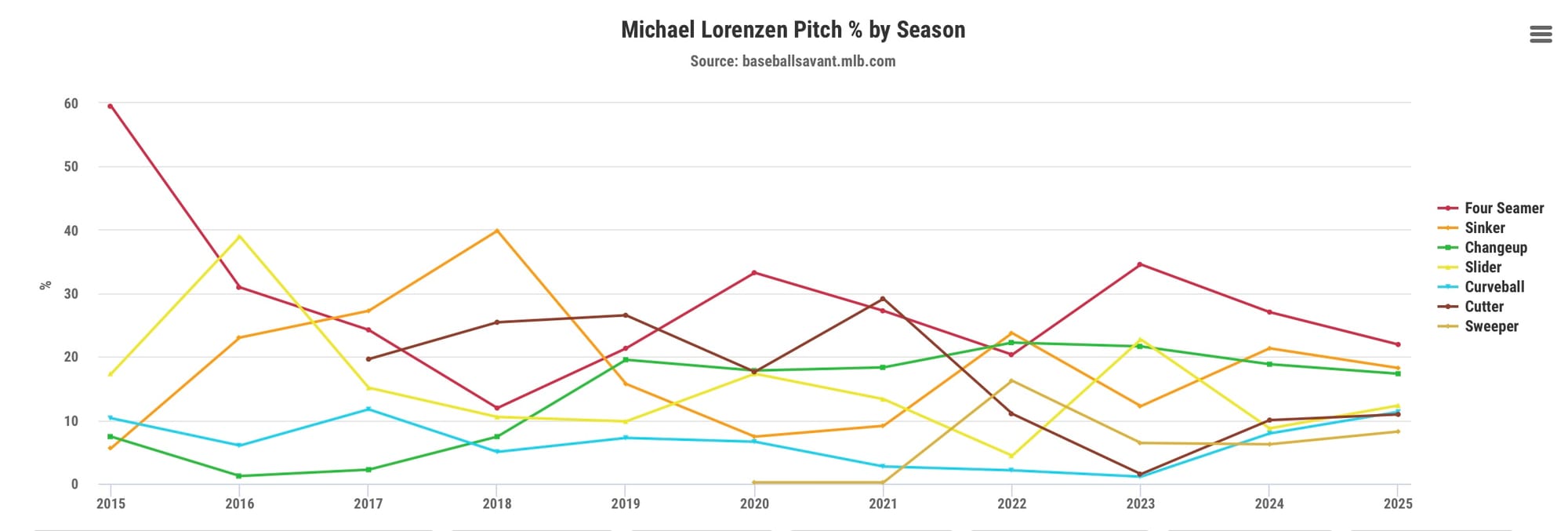
What becomes clear is that as Lorenzen’s four-seamer lost velocity, he turns more to his breaking stuff, most notably his curveball and sweeper, but his ability to throw all of his pitches with confidence is key.
Caleb Moody provides a more detailed analysis of Lorenzen’s recent career here. This passage is notable: “And limiting the long ball has been a real issue for Lorenzen as he's aged, allowing over 1.00 HR/9 in four straight seasons, including a very high 1.59 HR/9 clip in 2025, which amongst pitchers with at least 140.0 innings pitched last seasonplaced him in the Top 10 highest totals (ninth to be exact).”
So Lorenzen arrives at Coors Field with a warning label.
Can you share something cool?
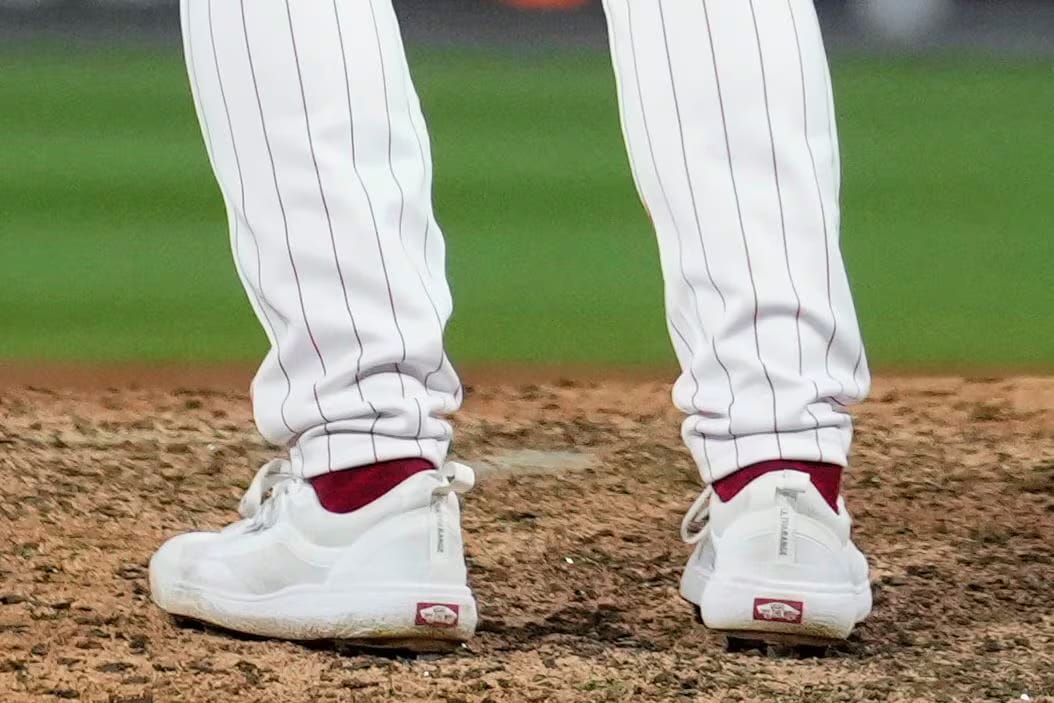
I can. Lorenzen is a Vans person, and he has a partnership with the company. (Read more about that here.) Since Vans was founded in Anaheim in 1966, the relationship makes sense.
If you’re curious about his shoe-design process, “Lorenzen customizes his Vans on the company's Web site like everybody else. Once he receives the shoes, he sends them to Custom Cleats in Holbrook, N.Y. Custom Cleats transforms them into cleats.”
He threw a no-hitter while with the Phililes in 2023, and, yes, his Vans are in the Hall of Fame — the only Vans in the building.
Why did he sign with the Rockies?
The most-obvious answer is that he needed a job, and the Rockies were willing to pay him $8 million. (Incidentally, the last time the Rockies paid more than more than $5 million for a free-agent starter was Kyle Kendrick in 2015.)
But I tend to think there’s a bit more to it.
I’ve written before that president of baseball operations Paul DePodesta is buiilding a team of nerds. He’s put together a front office of baseball staff who want to try new things as they attempt to solve the greatest puzzle in baseball: Coors Field. It makes sense, then, that in addition to pitching skills, the Rockies are looking for pitchers with a particular mindset.
I’ve not read any interviews with Lorenzen in which he discusses pitching at Coors, but I did spend some time in the Royals’ clubhouse in 2024 when they visited Coors Field — I talked with Cole Ragans, Seth Lugo, and Michael Wacha. One thing that became clear was that their rotation worked as a workshop: The pitchers collaborated closely with each other and the coaching staff to improve. This was largely started by Wacha, but pitchers would watch bullpen sessions and debrief together when the starter left a game.
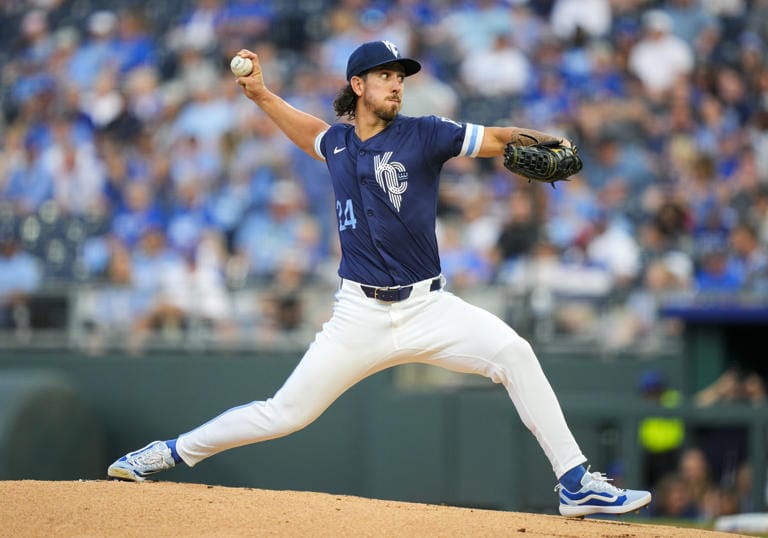
Lorenzen was in that environment for more than a year, and he seems like a player willing to try some things, which the Rockies’ coaching staff will certainly ask him to do.
Look, a player doesn’t have a seven-pitch mix because they’re passive. Lorenzen seems like he might be a prefect addition, and his pitch mix suggests he’ll bring the kind of repertoire that the coaching staff can use when trying to solve baseball at elevation.
He’s an experiment in the ultimate baseball laboratory.
Based on Byrnes’ comments to Thomas Harding, we can expect the Rockies to make one more addition to their rotation. The decision to sign Michael Lorenzen gives fans their first insight into Paul DePodesta’s thinking.
Closing thoughts
That’s it for this week.
We know that the Rockies reached agreements with all of the arbitration-eligible players yesterday, so now it’s a matter of finding that second starter and a first baseman. I expect them to move quickly.
Oh, they also picked up another reliever this week, Keegan Thompson.
As spring training approaches and Paul DePodesta and their team keep building, this will be a fun year to watch the Rockies.
Thanks for reading —
Renee
Rockies Pitch is a newsletter that focuses on Colorado Rockies baseball.
Find me on Bluesky at @ReneeDechert.com or send an email to Renee@RockiesPitch.com