So about the Colorado Rockies offense . . . .
How much have the Rockies improved in 2026?

One of my favorite Arizona Diamondbacks posters is Jack Sommers. Last earlier this week when D-backs fans were reeling from losing a series to the Rockies, he posted this:
D-backs wRC+ by position compared to MLB avg. 100 = league avg. Rank 21st overall
— Jack Sommers (@shoewizard59) August 13, 2026
Notable they're 14th in Runs scored/game (4.52 vs MLB avg 4.48)
18th in wRC+ with RISP 101 vs 103 MLB avg
17th w/runners on base 105 vs 105 MLB avg
16th in High Leverage 93 vs 96 MLB avg pic.twitter.com/ZKHNztinYL
We’ve seen that the Colorado Rockies have a better offense this season. For example, currently in terms of batting average, they are fourth (.255), eighth in OBP (.323), and third in SLG (.421). These are remarkable improvements over 2025 when they were 23rd in batting average (.237), 30th in OBP (.293), and 24th in SLG (.386). They also had a collective wRC+ of 74, the worst in MLB.
wRC+ has always been a tough metric on the Rockies, but I was curious to run Sommers’ D-backs numbers to see what it showed about the Rockies. Here’s what it looks like:
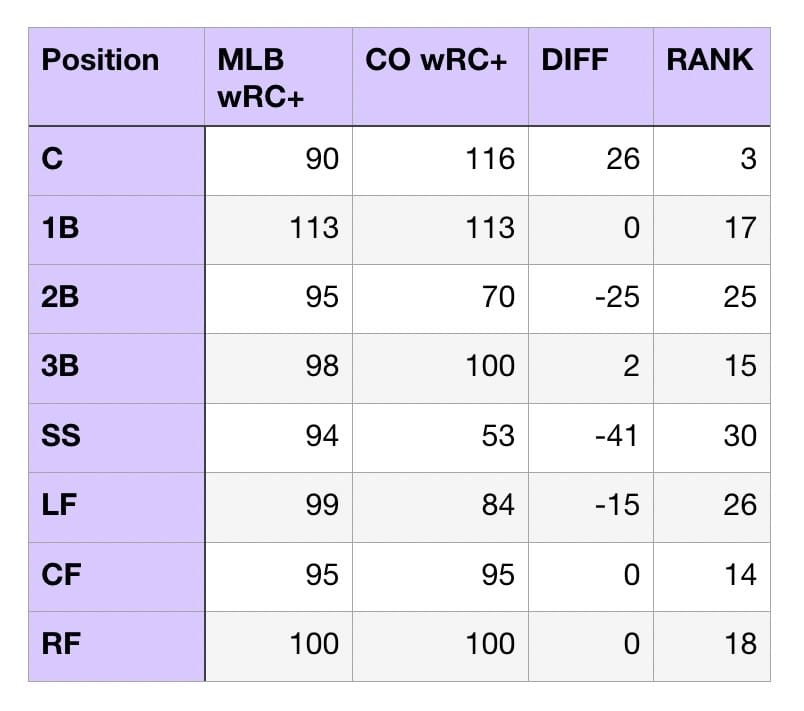
Also, in 2026, the Rockies collective wRC+ is 91, 28th in MLB, which is not awesome but also much improved over last season.
Clearly, the Rockies have made significant investments and changes this season. They have different coaching and better data to work with. In addition, president of baseball operations Paul DePodesta and general manager Josh Byrnes took steps during the offseason to “raise the floor” of this team. Some of those investments are paying off (while others are not).
But here are a few interesting takeaways from the wRC+ comparisons.
More of the Rockies offensive numbers are average or better — In two categories (catcher and third base), the Rockies are above the league average. In three categories (first base, center field, and right field), they are at league average. That’s what raising the floor looks like, and the fact that six of nine positions are at or above the MLB average gives a sense of where the numbers have improved.
Where the numbers are bad, they are very bad — The least-bad position is left field, and those numbers can probably be attributed to the Rockies using that position for players who have just been promoted or returned from injury (e.g., Sterlin Thompson’s 79 and Jordan Beck’s 43). Clearly, there’s a lot of roster churn through that position, which shows.
Second base is seeing the effects of Edouard Julien (65 wRC+) and Willi Castro (98 wRC+). Given that the Rockies have DFA’d Julien (who is now with the Isotopes) and promoted Connor Norby, it’s clear they are looking to address that part of their lineup. While second base is Castro’s best position, the Rockies like his ability to act as a utility player, so second base is a problem they will need to solve. Whether Norby is the answer to their question remains to be seen.
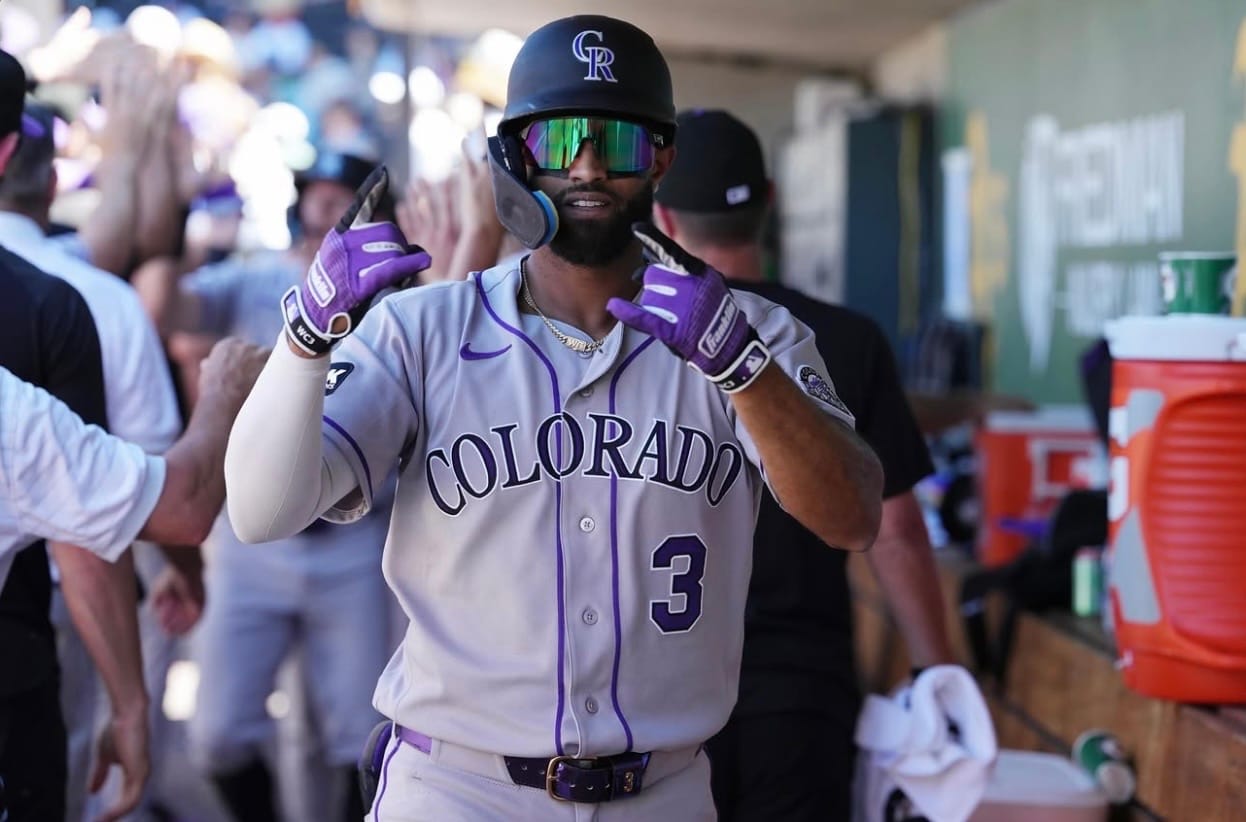
The biggest problem, however, is at shortstop, where Ezequiel Tovar is well below league average and is ranked last in MLB.
Tovar’s struggles have been well documented. However, he has quietly been improving. For example, his 25.2% K% no longer leads the league. (He comes in 34th.) Instead, that honor goes to Kyle Schwarber (34.0%) with second going to Hunter Goodman (33.0%). In fact, Willi Castro (27.3%) has a higher K% than Tovar does.
Actually, consider Tovar’s monthly numbers per FanGraphs:

Tovar we terrible in March and April and even worse in June and July. But check out those August numbers: a 120 wRC+. Granted, we are not yet halfway through the month, so it’s a small sample size, but the work Tovar did earlier in the summer appears to be paying off — some. He’s striking out less, making more contact, and even taking walks.
In other words, although Tovar’s offensive number as measured by wRC+ clearly dragged down the Rockies, that may be improving — and it will be a story to watch as the Rockies finish out their season. Tovar has had excellent defense and an inconsistent bat. If the Rockies can address his offensive issues, they have the potential for a solid shortstop in 2027.
What a difference Hunter Goodman makes — While Goodman is striking out a lot, there is no doubt his bat makes the Rockies a much better team, and he remains one of the best offense catchers in MLB. There’s little wonder other teams were interested in acquiring Goodman and that the Rockies set the price high for a trade. His bat can play anywhere, and he has significantly improved the Colorado Rockies.
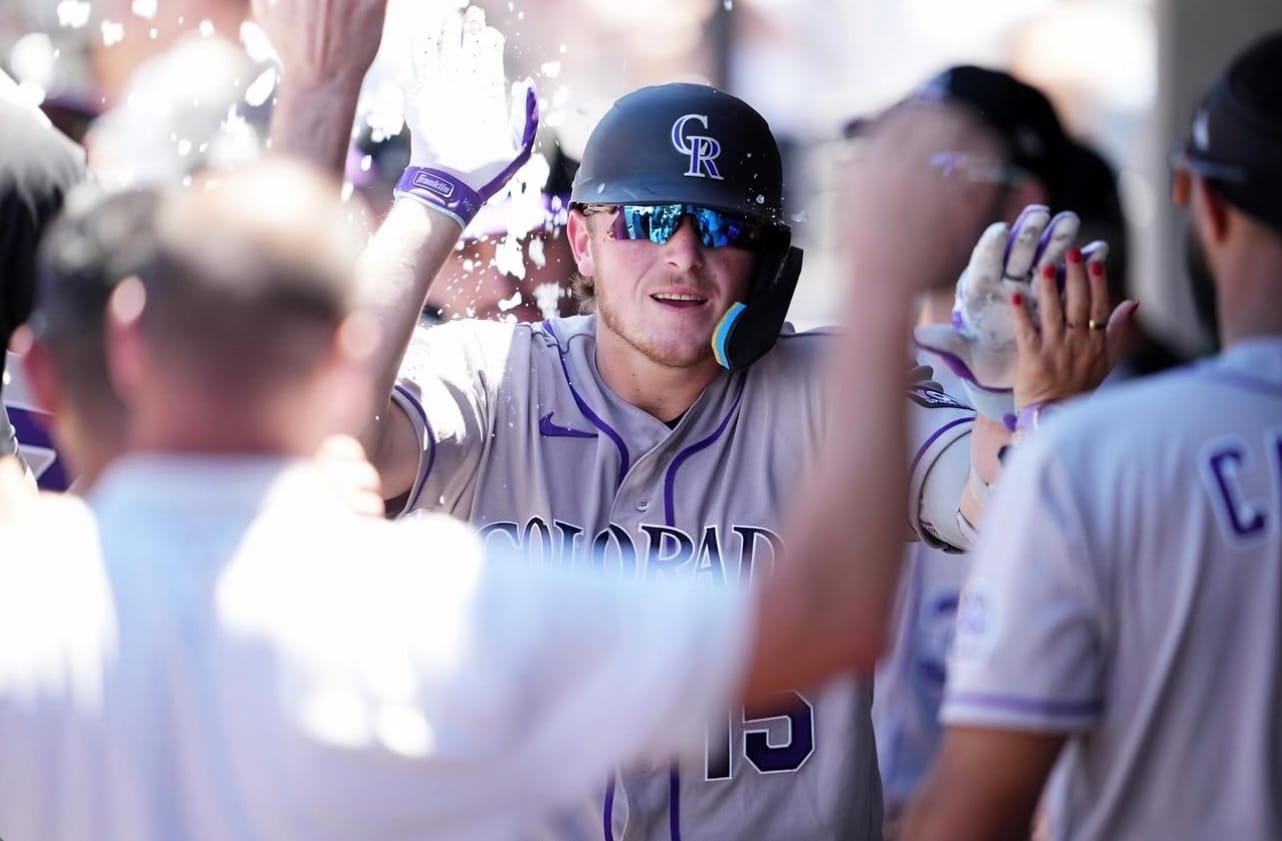
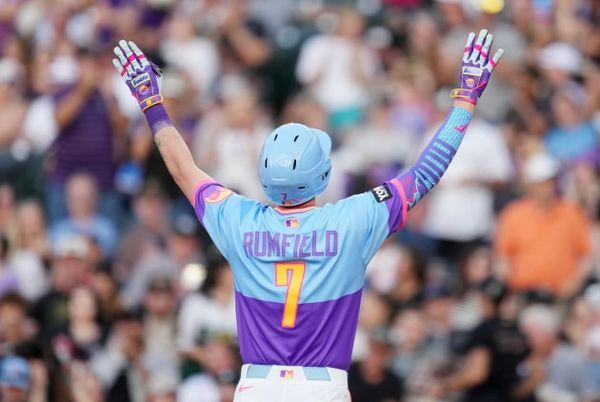
The Rockies finally have a good first baseman — Although he has cooled off a bit, TJ Rumfield remains an excellent offseason acquisition, and he marks a significant upgrade from Michael Toglia. Finally, the Rockies have consistency at first base. Whether Rumfield can carry this year’s success into 2027 will be a story to watch.
The outfield got better — Center field and right field are now consistent with the rest of MLB. This is no small accomplishment, and it’s largely the result of the Rockies trading for Jake McCarthy, promoting Cole Carrigg, and improving Mickey Moniak’s defense. (He’s still not a good defender, but he is also less bad.) In addition, Troy Johnston has made key contributions.
Conclusions — With six weeks left and a tough schedule ahead of them, the Rockies still have a long way to go.
However, this is a better team than they have fielded in some time. September will be an interesting month as I expect the Rockies to allocate playing time with an eye to building future their 2027 roster. What is Zac Veen’s place? Will Adael Amador become their primary second baseman? Does Troy Johnston have a future as a fourth outfielder with the Rockies?
When the season ends, I expect DePodesta and company to be busy as they release players they do not see as part of the Rockies future and work to acquire those they think may be prior to the coming lockout.
But the immediate question is this: Will the Rockies avoid another 100-loss season? We know they’re better.
Now we wait for that final total.
Closing thoughts
That’s it for this week.
The Rockies series with the San Francisco Giants is a big one. They have generally not played well at Oracle, but a Giants team that was not good before is worse now, and the question becomes whether they can rack up another win or two before heading back to Coors to meet an powerful, if uneven, Los Angeles Dodgers team.
Last night, they tallied a win. They need 14 more.
Stay tuned.
As always, thanks for reading —
Renee
Rockies Pitch is a newsletter that focuses on Colorado Rockies baseball.
Find me on Bluesky at @ReneeDechert.com or send an email to Renee@RockiesPitch.com